

- What are the critical design considerations when integrating the V48B24E250BN DC-DC converter into a high-density PCB layout with limited airflow?
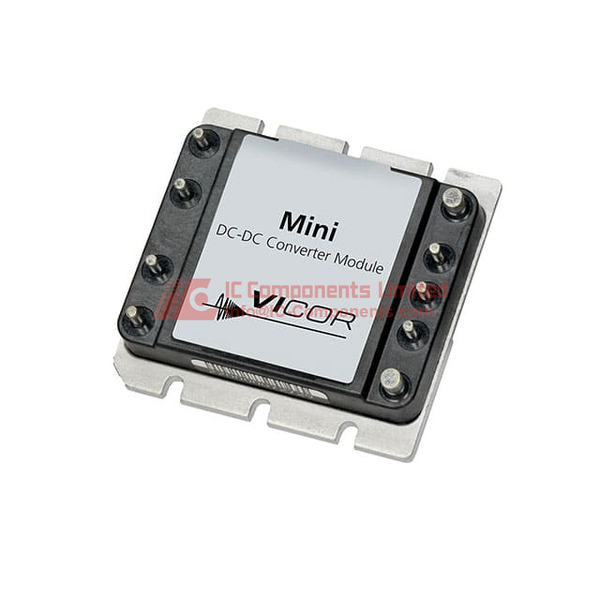
- When designing with the V48B24E250BN, thermal management is paramount due to its 250W output and 89% efficiency, which results in approximately 30W of heat dissipation under full load. The module’s compact 2.28" x 2.20" footprint demands careful PCB layout—ensure adequate copper pour on thermal pads, use thermal vias beneath the module, and maintain clearance from heat-sensitive components. Given its through-hole mounting, mechanical stability must be ensured during wave soldering. In confined spaces with low airflow, forced convection or a heatsink may be required to keep junction temperatures within the -10°C to 100°C operating range, especially near the upper limit.
- Can the V48B24E250BN be used in automotive applications requiring AEC-Q100 compliance or extended temperature operation beyond 100°C?
- No, the V48B24E250BN is not suitable for automotive or high-reliability environments requiring AEC-Q100 qualification. Its operating temperature range tops out at 100°C, and it lacks automotive-grade screening, burn-in testing, or documentation traceability. Additionally, it is marked as RoHS non-compliant, which may conflict with modern automotive supply chain requirements. For under-hood or engine bay applications, consider Vicor’s automotive-qualified modules or alternatives with wider temperature ranges and full compliance certifications.
- What input voltage transients or surges can the V48B24E250BN tolerate, and do I need additional input protection circuitry?
- The V48B24E250BN accepts a nominal input range of 36V to 75V DC, but it does not include built-in surge protection. In industrial or telecom environments with inductive load switching or lightning-induced transients, external input filtering and protection are strongly recommended. A TVS diode rated for >80V clamping voltage, along with an LC filter, should be added to suppress voltage spikes. Without such protection, repeated transients near or above 75V can degrade the module over time, especially in 48V nominal systems where load-dump events may exceed safe limits.
- Is the V48B24E250BN a drop-in replacement for older Vicor MINI series modules like the V48B24E200 or V48B24E300 in existing designs?
- While the V48B24E250BN shares the same 9-DIP package and pinout as other Vicor MINI series converters, it is not a direct functional replacement without validation. The 250W rating exceeds the V48B24E200 (200W) and falls short of the V48B24E300 (300W), so thermal and current delivery capabilities differ. Additionally, efficiency, transient response, and control pin behavior (e.g., enable, trim) may vary subtly. Always verify compatibility in your specific load profile and thermal environment. Migrating from a 300W module to the V48B24E250BN may require derating or additional cooling to avoid overcurrent or overheating conditions.
- How does the 3 kV isolation rating of the V48B24E250BN impact safety certification and creepage/clearance requirements in ITE systems?
- The 3 kV isolation in the V48B24E250BN supports basic insulation in ITE (Information Technology Equipment) per IEC 60950-1 or IEC 62368-1, but system-level certification still requires adherence to creepage and clearance distances on the PCB. Maintain at least 6.4 mm clearance between primary and secondary sides, and ensure no conductive traces or components bridge the isolation barrier. The module itself meets the isolation requirement, but the overall system design must account for pollution degree, altitude, and material group to pass safety testing. Do not rely solely on the converter’s isolation for end-product compliance.
- What are the risks of operating the V48B24E250BN near its minimum input voltage of 36V in a battery-powered or fluctuating supply environment?
- Operating the V48B24E250BN near 36V increases the input current significantly—up to ~8.7A at full load—which can cause voltage sag in weak supply systems and elevate conduction losses in wiring and connectors. Additionally, the UVLO (Undervoltage Lockout) threshold is not explicitly stated in the datasheet, so repeated brownouts may cause erratic shutdowns or cycling. In battery-powered applications, ensure the supply can sustain voltage above 36V under load, or implement a pre-regulator. Long-term operation at low input voltage also stresses input capacitors and may reduce module lifespan due to higher RMS currents.
- Can the V48B24E250BN be paralleled for higher current output, and what synchronization or load-sharing features does it support?
- The V48B24E250BN does not support active current sharing or master-slave paralleling out of the box. While it is technically possible to parallel multiple units with careful design, imbalances in output impedance and startup timing can lead to uneven load distribution and potential thermal runaway. Vicor’s proprietary current-share bus (CSB) is not available on this model. For scalable power solutions, consider Vicor’s Factorized Power Architecture (FPA) modules or newer BCM/PRM series with built-in paralleling support. If paralleling the V48B24E250BN is unavoidable, use external ballast resistors or diodes, but expect reduced efficiency and reliability.
- What long-term reliability concerns should be considered when deploying the V48B24E250BN in industrial environments with high vibration or thermal cycling?
- The V48B24E250BN’s through-hole mounting provides good mechanical strength, but repeated thermal cycling from -10°C to 100°C can stress solder joints and internal wire bonds over time. In high-vibration settings, ensure the PCB is securely fastened and consider conformal coating to prevent microcracks. The module lacks MIL-STD-883 or industrial lifetime testing data, so field failure rates in harsh environments are not well characterized. For mission-critical industrial systems, monitor operating temperatures and implement predictive maintenance. Consider conformal-coated or potted variants if available, or evaluate more ruggedized alternatives for 24/7 operation.
- Are there RoHS-compliant alternatives to the V48B24E250BN for new product designs requiring full environmental compliance?
- Yes, the V48B24E250BN is listed as RoHS non-compliant, which may disqualify it from use in EU or global markets with strict environmental regulations. Vicor offers newer modules in the same power class—such as the DCM series (e.g., DCM3623TA5K24A2C0)—that are fully RoHS-compliant and provide higher efficiency and digital control. While not pin-compatible, these alternatives support higher power density and better thermal performance. Migrating requires redesign but offers long-term compliance and lifecycle advantages. Always verify the latest compliance status with Vicor’s documentation, as legacy modules like the V48B24E250BN may be phased out.
- How should the output voltage of the V48B24E250BN be trimmed or adjusted for precision applications requiring exactly 24.0V ±1%?
- The V48B24E250BN supports output voltage trimming via an external resistor connected to the TRIM pin, typically allowing ±10% adjustment. However, achieving ±1% precision requires a high-tolerance trim resistor (0.1% or better) and stable reference conditions. Note that trimming affects regulation under load and temperature; recalibration may be needed after thermal stabilization. For applications like test equipment or medical devices requiring tight voltage control, consider using a post-regulator LDO or a digitally controlled DC-DC module instead. The V48B24E250BN is optimized for general-purpose 24V bus generation, not ultra-precise regulation.