


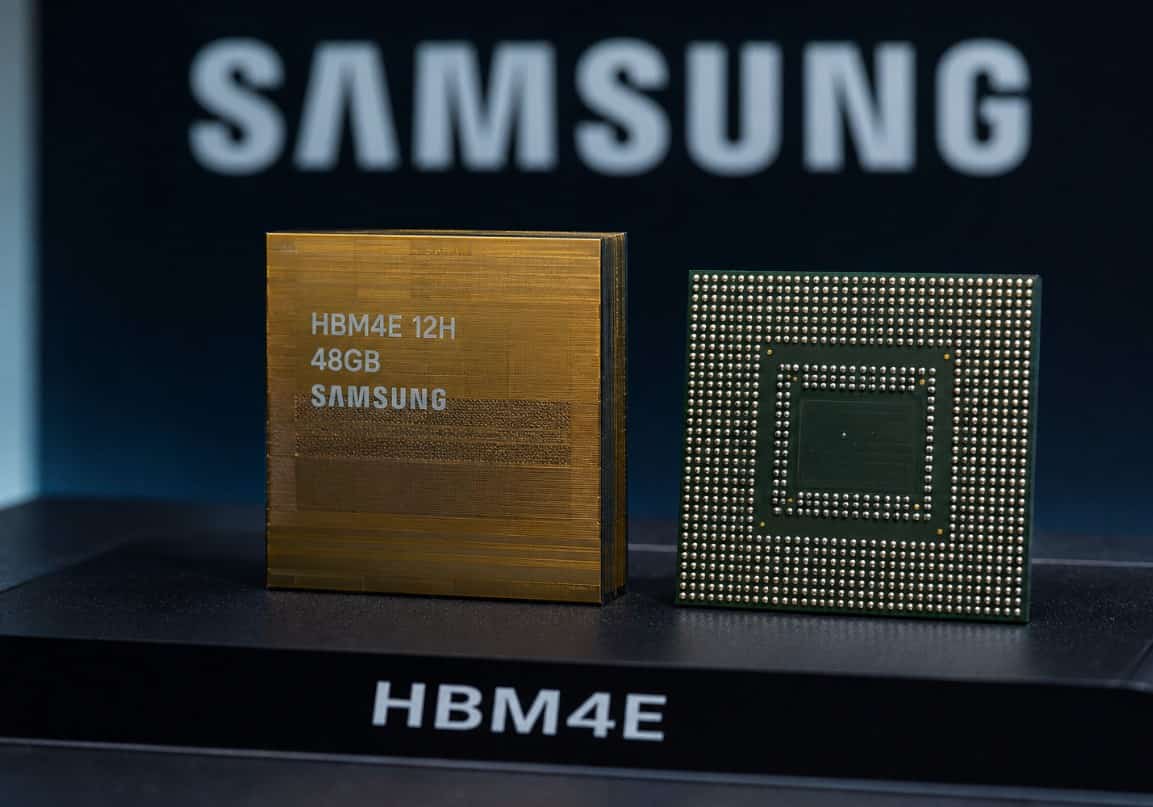
Samsung Electronics announced that it has begun delivering the industry’s first 12-high 48GB HBM4E samples to major global customers. Following the initial sample shipments and optimization process, Samsung plans to begin mass production of HBM4E in line with customers’ development schedules.
Samsung also said it is expanding its product lineup and will introduce 8-high 32GB and 16-high 64GB versions to meet customers’ diverse computing performance requirements.
HBM, or High Bandwidth Memory, is a core enabling component for AI accelerator chips, with its bandwidth and capacity directly affecting the efficiency of AI training and inference.
Samsung entered the HBM market in 2015, and its products have since gone through ten generations of development. In February 2026, Samsung began mass production of HBM4, becoming the first company in the world to achieve volume production of HBM4.
According to Samsung, the 12-high HBM4E, an enhanced successor to HBM4, is built on the company’s sixth-generation 10-nanometer-class (1c) DRAM process and a 4nm logic base die manufactured by Samsung Foundry. The new product delivers major gains in performance, capacity, power efficiency, and thermal management, and is designed for large language models, generative AI, and high-performance computing applications. Compared with HBM4:
Performance: HBM4E delivers a stable per-pin data rate of 14 Gbps, with scalability up to 16 Gbps to meet growing data-processing demands. Compared with HBM4, performance is improved by more than 20%, while memory bandwidth reaches as high as 3.6 TB/s per stack, helping maximize computing performance for large-scale models and next-generation AI systems.
Capacity: HBM4E offers 48GB of capacity, more than 30% higher than the previous generation. Samsung also plans to expand the lineup based on customer demand, including 32GB (8-high) and 64GB (16-high) configurations.
Power Efficiency and Thermal Performance: A low-power design and packaging optimization improve power efficiency by 16% and reduce thermal resistance by more than 14%, significantly enhancing heat dissipation and helping lower energy consumption in high-load AI data center environments.