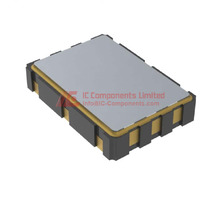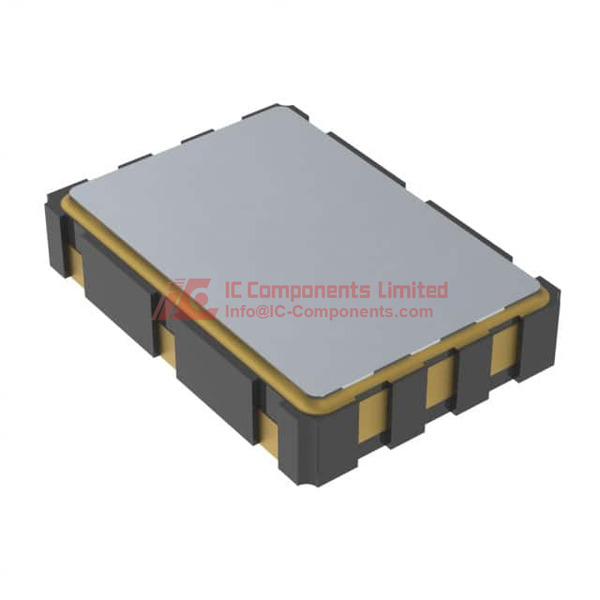


- Can 515CDB16M3840AAGR be used as a drop-in replacement for a fixed-frequency 16.384 MHz CMOS oscillator?
- 515CDB16M3840AAGR is a 16.384 MHz VCXO with CMOS output, so it can replace a fixed oscillator only if the circuit can tolerate the tuning behavior and control pin arrangement. In a fixed-clock design, the pull range, control-voltage biasing, and startup frequency need to be checked so the part powers up within the downstream PLL, codec, or timing device acceptance window. If the design never uses frequency trim, the VCXO control input should be held at the vendor-recommended midrange or reference bias level.
- What control-voltage range should I plan for when integrating 515CDB16M3840AAGR into a PLL or clock-cleanup loop?
- 515CDB16M3840AAGR is intended to be steered by an analog control voltage, so the loop filter and DAC range must fit the oscillator's absolute pull range of about +/-30 ppm. In practice, the control interface should keep the tuning voltage away from the rails and avoid injecting noise into the VCXO node, since that can degrade phase stability. Before finalizing the loop, verify the oscillator's transfer curve around the nominal 16.384 MHz operating point and confirm the PLL can center the device without saturating the control input.
- Is 515CDB16M3840AAGR suitable for designs that require a very clean timing reference for telecom or audio sample clocks?
- 515CDB16M3840AAGR can fit applications that need a 16.384 MHz CMOS reference with modest trim capability, especially where the load is a digital clock input rather than an RF stage. The +/-20 ppm stability and VCXO behavior make it more relevant when the system needs small corrections for synchronization. For applications with tighter jitter budgets, the full clock tree, supply filtering, and routing must be reviewed because a CMOS-output oscillator will usually be more sensitive to board noise than a differential timing source.
- What should I check before replacing a 16.384 MHz oscillator from another brand with 515CDB16M3840AAGR?
- When replacing another 16.384 MHz part with 515CDB16M3840AAGR, compare not just frequency and package, but also supply voltage, enable/disable behavior, pull range, and output logic compatibility. Some vendor equivalents differ in how the control voltage maps to frequency, so a part that is electrically close may still shift loop gain or trim center. It is also worth confirming the package land pattern, seated height, and pad recommendations because the device is a 6-SMD, no-lead component.
- Can 515CDB16M3840AAGR tolerate industrial temperature operation and long-term field use?
- 515CDB16M3840AAGR is specified for -40 C to 85 C operation, which covers many industrial environments if the board keeps the oscillator within its supply and thermal limits. Long-term stability will depend on how much of the pull range is consumed by aging, temperature drift, and control-loop offset. For fielded equipment, designers usually leave margin so the oscillator stays near the center of its tuning range after aging and board-level temperature gradients are included.
- How should I use the enable/disable function on 515CDB16M3840AAGR during power management?
- 515CDB16M3840AAGR includes an enable/disable function, so the control pin can be used to gate the clock when the downstream logic supports re-lock or restart behavior. The disable-state current is lower than the active current, but the system should still verify what happens to the clock receiver when the oscillator is re-enabled, including startup time and downstream metastability risks. If the clock feeds a PLL, the lock sequence after reactivation should be tested under worst-case supply and temperature conditions.
- What power-supply and decoupling practices are recommended for 515CDB16M3840AAGR?
- 515CDB16M3840AAGR runs from 3.3 V, so the supply rail should be clean, well-decoupled, and isolated from noisy switching loads when possible. Because VCXO frequency can move with control and supply disturbances, local bypassing close to the package and a low-impedance return path are practical requirements. If the rail is shared with digital logic, designers often add a ferrite bead or RC filtering only after confirming it does not create startup or transient issues.
- When is 515CDB16M3840AAGR a better choice than a crystal plus discrete oscillator circuitry?
- 515CDB16M3840AAGR is a stronger fit when the system needs a compact, surface-mount clock source with integrated buffering and analog trim capability. A discrete crystal solution may still be preferable if the design demands a custom loop topology, unusual voltage rails, or a lower-cost clock without frequency steering. The VCXO approach reduces external parts, but the tradeoff is that the control loop and supply integrity become part of the frequency error budget.
- Can 515CDB16M3840AAGR replace a temperature-compensated reference in a design that needs ppm-level synchronization?
- 515CDB16M3840AAGR provides +/-20 ppm stability and +/-30 ppm absolute pull range, so it is not a direct substitute for every temperature-compensated reference. It works well when the system needs modest correction around a nominal 16.384 MHz reference, such as tracking a network-derived control signal. For tighter holdover or more aggressive drift control, the engineering review should include aging, temperature profile, and whether the wider synchronization system can absorb the residual error.
- What PCB layout issues matter most for 515CDB16M3840AAGR?
- 515CDB16M3840AAGR should be placed so the supply bypass, ground return, and control-node routing stay short and quiet. Keep the CMOS output away from aggressive switching traces and avoid coupling noise into the VCXO control pin, since that can modulate the output frequency. Because the package is a small 6-SMD no-lead device, pad geometry and solder symmetry also matter for assembly reliability and consistent thermal coupling.
- How do I evaluate 515CDB16M3840AAGR as a substitute for a 16.384 MHz TCXO or a fixed XO?
- 515CDB16M3840AAGR should be compared against a TCXO or fixed XO based on whether the design needs active frequency trim. A VCXO is useful when a PLL or synchronization circuit must steer the clock, while a TCXO is usually simpler when temperature compensation is needed but external tuning is not. If the existing design never uses steering, the VCXO's extra control complexity may not bring a system-level advantage unless the replacement must preserve a known trim architecture.
- Are there reliability concerns if 515CDB16M3840AAGR is used in equipment that stays powered continuously?
- 515CDB16M3840AAGR can be used in continuous-duty equipment, but the validation should include supply ripple, thermal rise, and long-term drift under the actual board environment. Continuous operation makes it important to verify that the oscillator remains in the intended part of its tuning range after warm-up and aging, because a control loop that is centered during bench testing may shift in production enclosures. For high-availability equipment, it is also practical to test start/stop behavior if the enable input is used for maintenance or power sequencing.