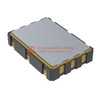
- What are the key design considerations when integrating the 515CDAM134200BAGR VCXO into a low-power IoT or battery-backed timing application?
- The 515CDAM134200BAGR draws up to 29mA at nominal supply and 22mA when disabled, making it suitable for systems where the oscillator can be power-gated. For always-on battery applications, these current levels may be significant relative to total system budget. The 3.3V supply requirement aligns with modern low-voltage logic, but designers should verify that the supply rail remains stable within ±5% during enable/disable transitions, as the frequency stability of ±20ppm depends on steady voltage. If the application requires sub-μA quiescent current during sleep states, external logic or a secondary reference clock may be necessary alongside the 515CDAM134200BAGR.
- Can the 515CDAM134200BAGR be used to replace older parallel-resonant crystal oscillators in legacy designs, and what are the practical migration hurdles?
- The 515CDAM134200BAGR is a complete VCXO module with integrated CMOS output, so it can directly replace discrete crystal + load capacitor + buffer circuits, provided the target frequency of 1.342 kHz and ±20ppm stability meet the application's requirements. However, legacy designs often relied on crystal pulls using variable capacitors or temperature compensation that may not align with the 515CDAM134200BAGR's ±30ppm absolute pull range. If the old design used pull-only frequency adjustment beyond ±30ppm, alternative frequency grades or a different oscillator architecture may be required. The 6-SMD, no-lead package of the 515CDAM134200BAGR also differs from older DIP or leaded packages, requiring PCB layout changes and requalification of thermal and mechanical mounting.
- How does the ±20ppm frequency stability of the 515CDAM134200BAGR affect long-term timekeeping accuracy in systems operating across the full -40°C to 85°C temperature range?
- The ±20ppm stability specification of the 515CDAM134200BAGR applies across the -40°C to 85°C range, meaning the output frequency can drift by up to ±20ppm relative to the nominal 1.342 kHz over temperature and time. For a 24-hour period, this translates to approximately ±1.7 seconds of error. In applications requiring better than ±20ppm accuracy over extended periods—such as time-stamping or periodic synchronization—the 515CDAM134200BAGR output should be calibrated against a more stable reference (GPS, NTP, or atomic clock) or used in a phase-locked loop with a precision reference. Industrial IoT systems operating near temperature extremes should account for the full ±20ppm window in their system-level error budget.
- What is the practical difference in performance between the 515CDAM134200BAGR and lower-cost RC oscillators when both operate at roughly 1.3 kHz, and when should each be chosen?
- RC oscillators typically exhibit ±10% frequency error and large temperature drift coefficients (often 1000+ ppm/°C), making them unsuitable for applications requiring stable clocking or time-keeping over temperature. The 515CDAM134200BAGR, by contrast, offers ±20ppm stability with a crystal-based resonator, making it orders of magnitude more accurate. RC oscillators cost less and consume slightly less power, but the 515CDAM134200BAGR is the correct choice for any system where frequency accuracy affects data integrity, sync timing, or regulatory compliance (e.g., telecom or audio standards). For simple event counting or non-critical timing, RC may suffice; for production systems with temperature variation or long operating intervals, the 515CDAM134200BAGR is the engineered choice.
- How should the enable/disable function of the 515CDAM134200BAGR be implemented to minimize transient frequency errors or metastability when switching between active and standby modes?
- The 515CDAM134200BAGR features a dedicated enable/disable control that allows the oscillator to be powered down to 22mA, but transitioning the output between enabled and disabled states can introduce phase jitter or transient glitches. Designers should ensure that downstream logic (counters, state machines, or data receivers) does not sample the 515CDAM134200BAGR output during the enable/disable window. A recommended practice is to gate the clock signal externally using a multiplexer and mask off the oscillator output for 1–2 clock cycles after a mode transition. Additionally, the enable/disable signal should be asynchronous-to-synchronous (through flip-flops in the destination clock domain) to avoid metastability in receiving logic.
- Is the 515CDAM134200BAGR suitable for ultra-low-frequency audio or subsonic instrumentation applications, and what are the bandwidth or harmonics considerations?
- The 515CDAM134200BAGR is designed as a timing oscillator rather than an audio signal generator. Its 1.342 kHz output is in the low audio frequency range, but the oscillator does not guarantee low phase noise, harmonic suppression, or waveform purity specified for audio applications. If used in audio instrumentation, the CMOS output should be filtered to remove switching noise and harmonics. The ±20ppm stability is adequate for sample-clock generation in low-rate ADCs or DACs, but not for precision analog audio synthesis. For subsonic instrumentation (1–10 Hz range), the 515CDAM134200BAGR is not applicable; designers would need a lower-frequency oscillator or divide-down logic from a higher-frequency source.
- What are the moisture and reliability implications of the MSL-1 rating of the 515CDAM134200BAGR in high-humidity manufacturing or field environments?
- MSL-1 (Moisture Sensitivity Level 1) means the 515CDAM134200BAGR has unlimited floor life and no special bake-out or storage requirements, making it one of the most robust choices for supply-chain and field reliability. Unlike MSL-3 or higher components, the 515CDAM134200BAGR can be stored at room temperature and humidity without risk of moisture ingress or solder-joint cracking. This is a significant advantage in high-volume manufacturing, field repair scenarios, or regions with high ambient humidity. However, MSL-1 does not guarantee immunity to corrosive atmospheres or salt spray; designs for marine or harsh industrial environments should still employ conformal coating or encapsulation of the populated board assembly.
- When should the 515CDAM134200BAGR frequency be pulled or trimmed using an external varactor or tuning circuit, and what are the accuracy trade-offs?
- The 515CDAM134200BAGR has an absolute pull range of ±30ppm, meaning its frequency can be adjusted via an external tuning voltage or varactor diode. This is useful for initial calibration or adaptation to system-level clock requirements. However, pulling frequency beyond ±30ppm is not supported by the device, and attempting to exceed this range may cause oscillation to cease or become unstable. If an application requires frequency adjustment beyond ±30ppm—such as large Doppler compensation or wide frequency-agile scenarios—a different VCXO architecture or a numerically-controlled oscillator (NCO) should be used instead. Pulling the 515CDAM134200BAGR within its ±30ppm range typically introduces 5–10ppm additional error due to temperature-frequency cross-coupling in the tuning network.
- How does the 6-SMD, no-lead package of the 515CDAM134200BAGR affect PCB layout, thermal management, and rework considerations in high-volume assembly?
- The 6-SMD, no-lead (SON) package of the 515CDAM134200BAGR eliminates lead inductance and allows compact placement, but it also eliminates solder fillets on the sides of the package, requiring reliable via-down or thermal-pad connectivity for grounding and heat dissipation. Poor solder reflow or voiding under the package can cause intermittent frequency drift or oscillation failure. During PCB design, ground vias should surround the 515CDAM134200BAGR pad, and the supply pin should be connected to a low-impedance power plane with short traces. For rework, X-ray inspection is recommended to verify solder connectivity. Hand rework with a hot-air station requires careful temperature profiling to avoid thermal shock or package delamination.
- Can the 515CDAM134200BAGR operate reliably at elevated temperatures near 85°C for extended industrial periods, and what degradation should be expected?
- The 515CDAM134200BAGR is rated for continuous operation from -40°C to 85°C, but the frequency stability of ±20ppm is specified across this full range, meaning it does not degrade further at sustained 85°C. However, crystal-based oscillators exhibit long-term aging (typically 1–5 ppm per year) that accumulates independently of temperature. In industrial systems operating continuously at 85°C over years, designers should expect cumulative frequency shifts of 10–25 ppm due to aging alone, in addition to the ±20ppm temperature-induced variation. If the application requires better long-term accuracy, periodic recalibration against an external reference or selection of a temperature-compensated TCXO variant may be necessary. The 22mA supply current at 85°C can also increase slightly due to leakage, requiring slightly higher power budget allocations in thermal worst-case analysis.