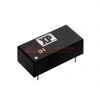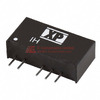


- What are the critical power supply sequencing requirements when designing with the XP Power IH2405D-H, and can it tolerate reverse polarity or transient overvoltage on its input rails?
- The IH2405D-H requires that the input voltage (VIN) be applied before or simultaneously with any output load connection to avoid latch-up or internal stress. It does not include built-in reverse polarity protection; external Schottky diodes or MOSFET-based protection circuits are recommended if reverse-battery scenarios are possible. The device can withstand input transients up to 40V for durations <100ms per IEC 61000-4-5, but sustained overvoltage above 36V may damage internal circuitry—use a TVS diode rated for 33V clamping for robust industrial deployment.
- Can the IH2405D-H be used in a 24V industrial bus system where ground loops or floating grounds are common, and what isolation specifications must be considered?
- Yes, the IH2405D-H supports operation in 24V industrial systems, but its functional isolation (not reinforced) limits it to basic ground-referenced applications. It provides 1500Vrms isolation between input and output, which is sufficient for signal-level isolation but not for safety-critical mains isolation. Avoid using it in systems requiring SELV/PELV compliance without additional galvanic isolation. Ensure the system ground reference is stable, as floating grounds can induce common-mode noise that affects regulation accuracy.
- What are the thermal derating guidelines for the IH2405D-H in enclosed industrial enclosures with ambient temperatures exceeding 50°C, and how should heat sinking be implemented?
- The IH2405D-H begins derating output power above 50°C ambient due to its internal junction temperature limits (Tj_max = 125°C). At 70°C ambient, maximum continuous output current drops by approximately 30%. For reliable long-term operation in hot environments, attach the module to an aluminum heat spreader (≥50 cm² surface area) with thermal interface material (TIM) having <0.5°C/W resistance. Avoid relying solely on PCB copper pour—forced airflow (>1 m/s) is recommended above 60°C.
- Is the IH2405D-H a suitable drop-in replacement for the RECOM R-78E5.0-1.0 in a 24V-to-5V power rail application, and what layout or filtering changes are needed?
- While both are 24V-to-5V DC-DC converters, the IH2405D-H is not a direct pin-for-pin replacement due to differences in enable logic, switching frequency (2.2MHz vs. 1.2MHz), and output ripple profile. The IH2405D-H requires additional input filtering (10µF ceramic + 100nF bypass) to meet EMI limits in sensitive analog circuits. Also, its enable pin is active-high with a 1.2V threshold—verify compatibility with your control logic. Re-layout the input/output capacitors per XP Power’s recommended footprint to avoid instability.
- How does the IH2405D-H perform under sustained overload or short-circuit conditions in field-deployed equipment, and what protection mechanisms are active?
- The IH2405D-H includes hiccup-mode current limiting and thermal shutdown. During a sustained short circuit, it cycles between full current (~2.5A) and shutdown every 100–200ms, limiting average power dissipation. This prevents catastrophic failure but may cause nuisance resets in downstream logic. For mission-critical systems, add an external foldback current limit or supervisory circuit to disable the module during prolonged faults. Note: repeated hiccup events accelerate aging of input capacitors—use polymer or tantalum types rated for high ripple current.
- What EMI/EMC challenges arise when integrating the IH2405D-H into a compact PCB with mixed-signal components, and how can conducted emissions be minimized?
- The IH2405D-H’s 2.2MHz fixed-frequency switching can couple noise into adjacent analog traces (e.g., ADC reference lines). To mitigate this, maintain a 5mm keep-out zone around the inductor and SW node, use a solid ground plane beneath the module, and add a π-filter (10µH + 2×22µF) at the input if EN55032 Class B compliance is required. Shielded inductors and placing the output capacitor as close as possible to the VOUT pin reduce radiated emissions by up to 12dBµV/m in typical layouts.
- Can the IH2405D-H operate reliably in automotive 12V/24V systems subject to load-dump transients (ISO 7637-2), and what external components are necessary for compliance?
- The IH2405D-H alone cannot survive ISO 7637-2 Pulse 5a (load dump up to 35V for 400ms). To achieve compliance, add an external 36V TVS diode (e.g., SMAJ33A) at the input and a 47µF bulk electrolytic capacitor in parallel with 1µF ceramic for energy absorption. Include a series fuse (1.5A slow-blow) to prevent fire risk during sustained overvoltage. Validate the complete solution with a transient generator, as module survival depends on total system impedance and clamping response time.
- What long-term reliability concerns should be considered when deploying the IH2405D-H in outdoor telecom infrastructure with wide temperature cycling (-40°C to +85°C)?
- The IH2405D-H is rated for -40°C to +85°C operation, but thermal cycling accelerates solder joint fatigue, especially if mounted on FR4 without thermal vias. Use via-in-pad under the thermal pad and conformal coating to prevent moisture ingress. Monitor input capacitor ESR degradation over time—electrolytics may dry out after 5+ years; prefer solid polymer capacitors. MTBF exceeds 1 million hours at 50°C ambient per Telcordia SR-332, but derate expected life by 30% in high-vibration environments unless mechanically secured.
- Are there known compatibility issues when paralleling multiple IH2405D-H modules for higher current output, and what synchronization or current-sharing techniques are effective?
- The IH2405D-H lacks built-in current-sharing or synchronization features, making direct paralleling unreliable due to ±10% output voltage tolerance. Even minor mismatches cause one module to carry >70% of the load, leading to thermal runaway. For >1A applications, use a master-slave configuration with external op-amp-based current balancing or select a dedicated multi-phase regulator. Alternatively, cascade two modules (e.g., 24V→12V→5V) to distribute thermal load while maintaining efficiency.
- How does the IH2405D-H compare to the Murata NXE1 series in terms of efficiency, footprint, and suitability for battery-powered industrial sensors?
- The IH2405D-H offers higher peak efficiency (92% vs. 88% for NXE1 at 500mA) and a smaller 6.5×6.5mm footprint, making it better for space-constrained designs. However, the NXE1 has lower quiescent current (15µA vs. 45µA), which is critical for battery longevity in sleep-mode sensors. If your application draws <10mA average current, the NXE1 may extend battery life by 20–30%. For always-on systems with >100mA load, the IH2405D-H’s superior efficiency justifies its higher IQ. Always validate total system power budget under real-world duty cycles.