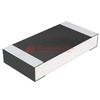
The Vishay Dale CRCW12062R67FNEB is a surface-mount thick film chip resistor offering 2.67 ohms resistance with ±1% tolerance in the standard 1206 (3216 metric) footprint. This component delivers 0.25W power dissipation capability while meeting AEC-Q200 automotive qualification standards, positioning it for applications requiring enhanced reliability under mechanical stress and thermal cycling conditions common in vehicular environments.
The resistor's thick film construction provides stable performance across a -55°C to 155°C operating temperature range with a temperature coefficient of ±200ppm/°C. Physical dimensions measure 3.20mm length by 1.60mm width with a maximum seated height of 0.60mm, allowing integration into compact PCB layouts where vertical clearance constrains component selection. The two-termination configuration supports standard reflow soldering processes compatible with automated assembly operations.
AEC-Q200 qualification indicates the component has passed automotive-grade stress testing protocols including temperature cycling, high temperature storage life, and mechanical shock resistance. This certification addresses reliability requirements in engine control units, battery management systems, power distribution modules, and infotainment electronics where component failure rates directly impact system availability. The CRCW series architecture balances current handling capacity with thermal management in circuits such as voltage dividers, current sensing networks, and gate drive resistor applications where precision resistance values influence analog signal conditioning accuracy.
Manufacturing conformance includes RoHS3 compliance for lead-free construction and REACH regulation adherence. Moisture sensitivity level 1 classification eliminates floor life restrictions and baking requirements prior to reflow, simplifying inventory management and production scheduling. The component ships in tape and reel packaging suitable for pick-and-place equipment integration. Standard substitutes include
RMCF1206FT2R67
for design flexibility during component sourcing or second-source qualification activities.
 RMCF1206FT2R67
Stackpole Electronics Inc
RES 2.67 OHM 1% 1/4W 1206
20000000
The 2.67 ohm resistance value serves specialized impedance matching requirements and low-value current sensing applications where standard E96 series values prove insufficient. Combined with 1% tolerance, the resistor enables precision analog front-end designs and power management circuits requiring tight resistance matching between parallel current paths or differential sensing configurations.
Design engineers working with automotive electronics frequently encounter situations where a specified component becomes unavailable due to supply chain constraints, end-of-life transitions, or cost optimization requirements. The Vishay Dale CRCW12062R67FNEB represents a precision 2.67-ohm thick film resistor qualified to AEC-Q200 standards, commonly deployed in current sensing, voltage division, and power management circuits where automotive-grade reliability is mandated. When this component requires replacement, the selection process must account for electrical parameters, thermal characteristics, physical footprint compatibility, and qualification status to maintain system performance and regulatory compliance.
This analysis examines several replacement candidates:
RMCF1206FT2R67
from Stackpole Electronics,
RMCF1206FT2R67
Stackpole Electronics Inc
RES 2.67 OHM 1% 1/4W 1206
20000000
RC1206FR-072R67L
from Yageo, and MCR10EZHF2R67 from Rohm Semiconductor. Each alternative offers distinct tradeoffs in tolerance specifications, power dissipation capability, temperature coefficient behavior, and automotive qualification scope that directly influence their suitability for specific circuit topologies.
 RC1206FR-072R67L
YAGEO
RES 2.67 OHM 1% 1/4W 1206
20000000

CRCW12062R67FNEB (1)
Understanding the Original Component Specifications
The CRCW12062R67FNEB from Vishay's CRCW series delivers 2.67 ohms resistance with ±1% tolerance in a standard 1206 (3216 metric) package. The 0.25W power rating at 70°C ambient allows current handling up to approximately 300mA continuous operation with adequate thermal margin. Thick film construction provides stable resistance characteristics across the -55°C to 155°C operating range, with ±200ppm/°C temperature coefficient ensuring predictable drift behavior in thermally dynamic automotive environments.
AEC-Q200 qualification confirms the component has passed automotive-specific stress testing including temperature cycling, biased humidity exposure, and mechanical shock protocols. This qualification becomes non-negotiable in applications subject to IATF 16949 quality system requirements or when supplying Tier 1 automotive manufacturers. The ROHS3 compliance and Moisture Sensitivity Level 1 rating simplify assembly processes by eliminating baking requirements and enabling extended floor life after package opening.
The 2.67-ohm value falls within the E96 resistance series, making it a standard offering across multiple manufacturers. This resistance sits in a range frequently used for inrush current limiting, gate drive damping, or shunt sensing applications where precision matters but extremely tight tolerances can be avoided through circuit calibration or trimming techniques.
Stackpole RMCF1206FT2R67 as Direct Functional Equivalent
The Stackpole Electronics
RMCF1206FT2R67
emerges as the most straightforward replacement, maintaining identical electrical specifications to the original Vishay component. Both parts share 2.67-ohm resistance, ±1% tolerance, 0.25W power rating, and 1206 package dimensions. The thick film construction methodology produces similar noise characteristics and long-term stability profiles, with the ±100ppm/°C temperature coefficient in the RMCF series actually providing tighter drift performance compared to the CRCW's ±200ppm/°C specification.
RMCF1206FT2R67
Stackpole Electronics Inc
RES 2.67 OHM 1% 1/4W 1206
20000000
This improved temperature coefficient translates to more stable operation in circuits where ambient temperature varies significantly or self-heating occurs during high-power operation. In a current sensing application operating between -40°C and 125°C junction temperature, the RMCF would exhibit approximately half the resistance drift of the CRCW over the same thermal excursion, potentially reducing calibration requirements or improving measurement accuracy by 0.1% or more depending on baseline conditions.
The RMCF series carries AEC-Q200 qualification equivalent to the CRCW, satisfying automotive reliability requirements without introducing qualification gaps. Component height remains within the 0.60mm maximum envelope, ensuring compatibility with automated pick-and-place equipment and existing PCB keepout zones. The tape and reel packaging format matches standard 1206 carrier dimensions, requiring no changes to feeder configuration or assembly programs.
One consideration involves manufacturer-specific lot-to-lot consistency and resistance distribution within the ±1% tolerance band. Vishay and Stackpole employ different trimming methodologies during thick film deposition, which can result in statistical differences in how components cluster within the tolerance window. Circuits employing ratio matching or requiring specific resistance centroid values may need incoming inspection or tighter purchasing specifications to maintain matched pairs or resistance tracking across temperature.
Yageo RC1206FR-072R67L for Cost-Sensitive Designs
The Yageo
RC1206FR-072R67L
presents an alternative with ±1% tolerance and 0.25W power rating in the same 1206 footprint, but introduces specification differences that affect application suitability. The temperature coefficient typically falls in the ±200ppm/°C range for Yageo's RC series, matching the original CRCW behavior. However, the automotive qualification status requires verification on a lot-by-lot basis, as Yageo's RC series includes both automotive-qualified and standard commercial grades depending on the ordering code suffix.
RC1206FR-072R67L
YAGEO
RES 2.67 OHM 1% 1/4W 1206
20000000
This component finds primary application in cost-optimized designs where AEC-Q200 qualification may not be contractually mandated or in non-safety-critical circuits within automotive systems. The thick film construction provides adequate stability for general-purpose applications including pull-up/pull-down functions, filter networks, or voltage dividers where drift performance does not directly affect system accuracy. Power dissipation characteristics remain comparable to the CRCW, with similar thermal resistance from junction to ambient enabling equivalent current handling.
The RC series typically exhibits slightly higher contact resistance variability at the termination interfaces compared to Vishay's CRCW series, which may affect circuits operating at very low voltages or requiring four-wire sensing techniques. In shunt current measurement applications below 100mV drop, this contact resistance variation can introduce 0.2% to 0.5% additional uncertainty unless accounted for through calibration. The lower cost per unit (typically 15-25% less than Vishay CRCW in volume quantities) makes this tradeoff acceptable in many commercial automotive applications.
Physical dimensions conform to IPC-7351 standards for 1206 components, with termination wrap-around extending 0.5mm minimum on the component ends. This provides adequate solder joint strength for mild mechanical stress environments but may require additional mechanical support or conformal coating in high-vibration applications such as engine bay mounting or off-road vehicle installations.
Rohm MCR10EZHF2R67 with Enhanced Power Handling
Rohm's MCR10EZHF2R67 diverges from the previous alternatives by offering ±1% tolerance but in a physically different package approach. The MCR10 series uses a 1206 footprint but with a thicker film deposition that can handle higher pulse power and transient events. The continuous power rating remains at 0.25W, but the thermal mass improvement allows better energy absorption during inrush or fault conditions common in automotive power distribution circuits.
The temperature coefficient specification for the MCR10 series typically ranges from ±200ppm/°C to ±300ppm/°C depending on resistance value, with the 2.67-ohm value falling toward the lower end of this range. This makes the component suitable for applications where steady-state drift matters less than transient survivability. Overcurrent protection circuits, soft-start networks, and gate drive damping applications benefit from the enhanced pulse handling without requiring physically larger components or additional heat sinking.
AEC-Q200 qualification coverage for Rohm's MCR series depends on the specific resistance value and ordering code. The "EZ" series designation indicates standard automotive qualification, but designers must verify that the 2.67-ohm value falls within the qualified resistance range for their required temperature grade. Rohm typically qualifies Grade 1 (-40°C to 125°C) and Grade 2 (-40°C to 105°C) ranges separately, with some resistance values only available in specific grades.
The thicker film construction introduces slightly higher manufacturing cost compared to standard 1206 resistors, typically 10-15% premium over the Vishay CRCW. This cost difference becomes justified in circuits experiencing repetitive transient stress or where reducing component count through higher individual component capability simplifies design. A single MCR10 might replace a standard 1206 resistor plus external transient suppression in some topologies.
Comparison Summary: Key Differences Across Alternatives
Direct comparison of the four components reveals distinct performance profiles suited to different design priorities:
- The Vishay CRCW12062R67FNEB serves as the baseline with proven AEC-Q200 qualification, ±200ppm/°C temperature coefficient, and broad supply chain availability. The Stackpole
RMCF1206FT2R67offers identical specifications with improved ±100ppm/°C temperature coefficient, making it the preferred choice for temperature-sensitive applications requiring maximum drift stability. The Yageo
RMCF1206FT2R67
Stackpole Electronics Inc
RES 2.67 OHM 1% 1/4W 1206
20000000
RC1206FR-072R67Lprovides cost reduction with equivalent electrical performance but requires qualification verification, positioning it for commercial automotive tiers where cost optimization takes priority over premium vendor selection. The Rohm MCR10EZHF2R67 adds transient handling capability at moderate cost premium, targeting circuits with pulse loading or fault exposure.
RC1206FR-072R67L
YAGEO
RES 2.67 OHM 1% 1/4W 1206
20000000
- Tolerance specifications remain consistent at ±1% across all options, ensuring resistance accuracy requirements transfer directly. Power dissipation holds at 0.25W for continuous operation, though the Rohm variant handles short-term overload more effectively. All maintain the 1206 footprint for drop-in physical compatibility, though terminal plating and solder joint strength vary slightly by manufacturer. Temperature coefficient emerges as the primary electrical differentiator, with the Stackpole option delivering measurable improvement in thermal drift performance.
- Qualification status represents the most significant selection constraint. The Vishay CRCW and Stackpole RMCF carry unambiguous AEC-Q200 qualification across their entire resistance range. The Yageo RC requires specification verification for automotive-qualified lots. The Rohm MCR needs resistance value and temperature grade confirmation against qualification documents. Projects under IATF 16949 quality systems or supplying Tier 1 automotive manufacturers must prioritize qualified options with full traceability.
Practical Validation Methods Using Stackpole RMCF1206FT2R67
Verification of the Stackpole
RMCF1206FT2R67
as a replacement begins with baseline resistance measurement using a four-wire ohmmeter capable of sub-ohm accuracy. The measurement should be performed at 25°C ambient with less than 1mA test current to avoid self-heating effects. Expected reading falls within 2.6433 to 2.6967 ohms for parts at the tolerance extremes, with typical production lots clustering near 2.67 ohms nominal. Any deviation beyond the ±1% tolerance band indicates handling damage, moisture absorption, or supplier quality issues requiring investigation.
RMCF1206FT2R67
Stackpole Electronics Inc
RES 2.67 OHM 1% 1/4W 1206
20000000
Temperature coefficient validation involves controlled thermal cycling while monitoring resistance. The component should be mounted to a temperature-controlled substrate with thermocouple placement within 2mm of the resistor body. Resistance measurements taken at -40°C, 25°C, 85°C, and 125°C map the actual drift behavior against the ±100ppm/°C specification. A 100°C temperature swing from 25°C to 125°C should produce less than 0.27-ohm resistance change (100ppm/°C × 100°C × 2.67Ω = 0.0267Ω). Deviations exceeding this indicate temperature coefficient specification mismatches or thermal interface problems.
Power dissipation verification requires mounting the resistor to the actual PCB stackup and copper weight used in production. Apply increasing current levels while monitoring component surface temperature with thermal imaging or surface thermocouple. At 0.25W dissipation (approximately 306mA through 2.67 ohms), surface temperature should stabilize below 155°C maximum rating with adequate margin. If temperature rise exceeds 80°C above ambient at rated power, thermal design requires improvement through copper pour enlargement, thermal via addition, or airflow enhancement.
Current sensing applications need noise and AC impedance characterization if the resistor serves as a shunt element. The thick film construction inherently produces Johnson noise of approximately 0.33 nV/√Hz at room temperature for 2.67 ohms. This sets the theoretical measurement floor for any current sensing circuit. Parasitic inductance for a 1206 package remains below 1nH, making impedance effectively resistive up to several megahertz. Frequency response testing should confirm no resonance or impedance anomalies within the circuit's operating bandwidth, particularly in switching power supply or motor drive applications where high di/dt transients exist.
Decision Framework for Replacement Selection
Selection among the alternatives follows a priority hierarchy based on application constraints and design requirements. Applications requiring maximum temperature stability or operating across wide thermal ranges should specify the Stackpole
RMCF1206FT2R67
for its superior ±100ppm/°C temperature coefficient. This includes precision current sensing, voltage reference networks, and instrumentation circuits where drift directly affects measurement accuracy. The modest cost premium over the original Vishay component becomes negligible compared to the performance improvement in thermally demanding environments.
RMCF1206FT2R67
Stackpole Electronics Inc
RES 2.67 OHM 1% 1/4W 1206
20000000
Cost-sensitive designs with confirmed commercial automotive qualification needs can adopt the Yageo
RC1206FR-072R67L
after verifying AEC-Q200 status for the specific production lot. This path suits high-volume consumer automotive applications where qualification burden is already established and per-unit cost reduction accumulates significantly across production volumes. The specification match to the original CRCW in all parameters except supplier name makes this a low-risk substitution once qualification is confirmed.
RC1206FR-072R67L
YAGEO
RES 2.67 OHM 1% 1/4W 1206
20000000
Circuits experiencing transient stress, pulse loading, or fault conditions benefit from the Rohm MCR10EZHF2R67 despite its wider temperature coefficient tolerance. The enhanced thermal mass and pulse handling capability reduce failure risk in power distribution, inrush limiting, and protection circuits where momentary overload occurs regularly. The component selection trades steady-state drift performance for transient survivability, a favorable exchange in applications where environmental temperature remains stable but electrical stress varies significantly.
Projects maintaining the original Vishay CRCW12062R67FNEB gain supply chain diversification value by qualifying multiple sources simultaneously. Dual-sourcing the Vishay CRCW and Stackpole RMCF provides equivalent performance across both suppliers while mitigating allocation risk during component shortages. The electrical interchangeability and identical qualification status make this a practical strategy for production continuity without technical compromise. Manufacturing can be instructed to accept either component during assembly without part number distinction or rework procedures.