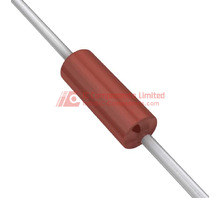
The CMF552K2300BHEK from Vishay Dale represents a precision metal film resistor engineered for applications demanding tight tolerance control and reliable performance across extended temperature ranges. This half-watt through-hole component delivers 2.23 kΩ resistance with ±0.1% tolerance, positioning it for measurement circuits, instrumentation amplifiers, and precision voltage dividers where standard 1% or 5% tolerance resistors cannot meet design requirements.
Metal film construction provides inherent advantages in noise characteristics and long-term stability compared to carbon composition alternatives. The ±50ppm/°C temperature coefficient ensures resistance drift remains predictable across the -55°C to 175°C operating range, making the CMF552K2300BHEK suitable for automotive electronics, industrial control systems, and medical devices where ambient conditions vary significantly. This temperature performance maintains circuit accuracy in both cold-start scenarios and elevated operating temperatures found in power supply regulation stages or sensor interface circuits.
The axial lead configuration measuring 0.090" diameter by 0.240" length facilitates integration into prototypes, low-volume production, and legacy equipment maintenance where surface-mount alternatives cannot be applied. Through-hole mounting provides mechanical robustness in applications subject to vibration or thermal cycling, while the two-terminal design simplifies hand assembly and rework procedures. Bulk packaging supports engineering evaluation and small-batch manufacturing without tape-and-reel handling requirements.
Flame retardant coating and moisture resistant construction address reliability concerns in harsh environments. These protective features extend operational life in industrial enclosures with elevated humidity, outdoor installations, or equipment operating near heat-generating components. The safety-rated construction aligns with requirements for test equipment, laboratory instrumentation, and telecommunications hardware where component failure modes must be controlled.
The 0.5W power rating accommodates moderate current levels while maintaining thermal performance within the specified operating range. This dissipation capability suits applications including analog-to-digital converter reference networks, op-amp feedback paths, and filter circuits where power handling exceeds typical 1/4W resistor capabilities but does not require full 1W derating margins. The CMF55 series designation indicates Vishay Dale's established product line with documented reliability data and consistent electrical characteristics across production lots.
ROHS3 compliance and REACH-affected status reflect current material restrictions for electronic components distributed in regulated markets. The EAR99 ECCN classification and 8533.21.0090 HTSUS code provide necessary documentation for international procurement and customs processing. Active product status confirms ongoing manufacturing support and availability for new designs requiring precision metal film resistors in axial through-hole format.

CMF552K2300BHEK (1)
CMF552K2300BHEK Replacement Overview
When a design calls for Vishay Dale CMF552K2300BHEK and the original source is constrained by lead time, approved vendor policy, or lifecycle risk, the replacement task is not simply matching 2.23 kOhm resistance. This part sits in a precision through-hole resistor class where tolerance, temperature drift, long-term stability, body style, and coating system can affect calibration margin, analog accuracy, and field reliability. In practical sourcing work, equivalent part selection usually starts with form factor and resistance accuracy, then moves into thermal behavior, environmental robustness, and circuit function.
For projects looking for a CMF552K2300BHEK equivalent, the most relevant alternatives are Vishay Dale CMF552K2300FHEK, Yageo MFR-50FBF52-2K23, KOA Speer MF1/2DCT52R2231F, and TE Connectivity Holsworthy LR1F2K23. These options belong to the same general family of axial metal film resistors, but they do not serve equally well in every design. Some are closer procurement substitutes for general precision use, while others are better treated as conditional alternatives after drift, derating, and assembly-fit review.
Understanding Where Vishay Dale CMF552K2300BHEK Fits in a Design
Vishay Dale CMF552K2300BHEK is a 0.5 W axial metal film resistor with 2.23 kOhm nominal resistance, ±0.1% tolerance, and ±50 ppm/°C temperature coefficient. That combination places it in a precision through-hole segment commonly used in current sensing support networks, gain-setting paths, instrumentation front ends, reference dividers, industrial control boards, and repair situations where an existing BOM already uses axial leaded parts.
The more meaningful engineering question is not whether another resistor can measure 2.23 kOhm on a bench meter, but whether it will behave similarly inside the application envelope. In low-drift analog circuits, the resistor’s temperature coefficient and moisture performance can alter offset or gain over time. In power-loaded nodes, body size and film construction influence hot-spot behavior and resistance shift. In high-mix manufacturing or maintenance environments, lead diameter, body length, and coating type can also affect insertion, soldering profile, and post-cleaning stability.
Selection Logic for a CMF552K2300BHEK Equivalent
A practical replacement flow for CMF552K2300BHEK usually follows five filters.
Electrical Match for CMF552K2300BHEK
The first screen is nominal resistance, tolerance, and power rating. A candidate should keep the 2.23 kOhm value exactly, since this is a non-E24 precision value often chosen intentionally for ratio accuracy or current setpoint trimming. Moving to 2.2 kOhm may be acceptable in some repair cases, but it is not a true equivalent for regulated production designs.
Tolerance should remain at ±0.1% where the original circuit depends on absolute accuracy, channel matching, or calibration-free assembly. A looser ±1% part may still function in biasing or pull-network applications, but it changes the original design intent.
Thermal and Drift Behavior Around CMF552K2300BHEK
The original Vishay Dale part carries a ±50 ppm/°C temperature coefficient. A substitute with similar or lower TCR is generally preferred for analog signal chains, measurement nodes, and temperature-varying field equipment. Even when nominal resistance is identical, a higher TCR part can create more output drift than expected over enclosure temperature swing.
Mechanical Compatibility with CMF552K2300BHEK
CMF552K2300BHEK uses an axial package with a compact body. For retrofit, hand assembly, or wave-soldered legacy boards, lead spacing and body length need review. A replacement that is electrically acceptable but physically longer may create stress near bends, interfere with neighboring parts, or sit too high above the board.
Environmental and Reliability Fit for CMF552K2300BHEK
The original part is described as flame retardant, moisture resistant, and safety metal film. That matters in industrial, power-adjacent, and long-service applications. Not every precision metal film resistor family is marketed with the same environmental positioning, so this point separates a direct operational substitute from a nominal catalog match.
Procurement Practicality for CMF552K2300BHEK
Some alternatives are easier to source globally or from multiple franchised channels. In ongoing production, second-source depth can outweigh a small package difference, provided validation confirms no circuit-level penalty.
Best Direct Alternative: Vishay Dale CMF552K2300FHEK
Among available replacement paths, Vishay Dale CMF552K2300FHEK is the closest alternative to CMF552K2300BHEK because it remains within the same CMF55 family, same manufacturer, same resistance value, same axial metal film construction, and usually the same basic electrical class. In many Vishay ordering schemes, suffix differences often reflect packaging or lead finish variants rather than a change in resistor element performance.
Why Vishay Dale CMF552K2300FHEK can replace CMF552K2300BHEK:
- It preserves the strongest continuity across electrical behavior, mechanical form, and manufacturer process controls. For engineering teams trying to avoid requalification overhead, staying inside the Vishay Dale CMF55 platform reduces uncertainty in overload response, film stability, coating chemistry, and long-term drift pattern.
Key differences from CMF552K2300BHEK:
- The primary difference is likely ordering or packing code detail rather than core resistor function. Even so, the suffix should be checked against the current Vishay ordering guide to confirm bulk format, lead finish, and any screening distinction before BOM conversion.
Applicable scenarios for Vishay Dale CMF552K2300FHEK:
- It is the strongest fit for production continuity, regulated maintenance, precision analog repair, and documentation-sensitive designs where engineering wants the smallest possible deviation from CMF552K2300BHEK.
Limitations of Vishay Dale CMF552K2300FHEK:
- This option depends on actual availability. If the suffix change maps to a packaging configuration not suited to the assembly line, that can still be a logistics issue even when the resistor itself is electrically aligned.
Yageo MFR-50FBF52-2K23 as a CMF552K2300BHEK Alternative
Yageo MFR-50FBF52-2K23 is a reasonable cross for teams seeking a 2.23 kOhm 0.5 W precision axial metal film resistor from a large-volume supplier with broad channel presence.
Why Yageo MFR-50FBF52-2K23 can replace CMF552K2300BHEK:
- It aligns with the core replacement criteria: 2.23 kOhm nominal value, 0.5 W class, axial through-hole format, and precision tolerance availability. In many commercial and industrial analog circuits, that places it within the workable replacement window.
Key differences from CMF552K2300BHEK:
- The first review point is temperature coefficient and stability positioning at the exact orderable grade. Yageo precision axial series can vary by suffix, and some versions may not mirror the Vishay CMF55 environmental characterization one-for-one. Body dimensions and coating finish can also differ slightly, which matters on tightly packed boards or for cosmetic consistency in service parts.
Applicable scenarios for Yageo MFR-50FBF52-2K23:
- This part fits general precision through-hole designs, maintenance procurement where multi-source support is needed, and cost-sensitive production where the resistor is used in a stable ambient environment rather than a drift-sensitive measurement path.
Limitations of Yageo MFR-50FBF52-2K23:
- Before using it as a CMF552K2300BHEK replacement in instrumentation or calibrated analog stages, the exact TCR, voltage rating, and moisture performance should be checked at the specific Yageo ordering code level. Cross-family assumptions are not sufficient.
KOA Speer MF1/2DCT52R2231F as a CMF552K2300BHEK Alternative
KOA Speer MF1/2DCT52R2231F is another credible substitute in the precision axial metal film category and is often considered when approved vendor lists include KOA for industrial control and power-related assemblies.
Why KOA Speer MF1/2DCT52R2231F can replace CMF552K2300BHEK:
- It offers the same nominal 2.23 kOhm value in a 1/2 W axial metal film format, making it electrically close enough for many resistor replacement workflows. KOA’s metal film resistor families are generally well regarded for stable operation in conventional through-hole applications.
Key differences from CMF552K2300BHEK:
- The most likely differences are body dimensions, derating curve shape, and available TCR grade. Depending on the exact series variant, KOA may provide the resistance and tolerance match but with slightly different environmental or pulse handling behavior than Vishay Dale CMF55.
Applicable scenarios for KOA Speer MF1/2DCT52R2231F:
- It works well in industrial electronics, control cards, interface boards, and repair situations where the original Vishay part is not mandatory and board-level space is not unusually constrained.
Limitations of KOA Speer MF1/2DCT52R2231F:
- For low-level analog conditioning or ratio-critical divider networks, a direct check of TCR and long-term stability is advisable. Matching the value and wattage alone does not guarantee the same drift profile over seasonal temperature cycling.
TE Connectivity Holsworthy LR1F2K23 as a CMF552K2300BHEK Alternative
TE Connectivity Holsworthy LR1F2K23 is commonly considered when a design needs a recognized through-hole metal film resistor family with broad historical use in industrial and general-purpose electronics.
Why TE Connectivity Holsworthy LR1F2K23 can replace CMF552K2300BHEK:
- It can provide the same 2.23 kOhm resistance in an axial metal film form, and the LR series has long been used in replacement and second-source scenarios where a stable leaded resistor is needed.
Key differences from CMF552K2300BHEK:
- The LR series is often positioned more as a dependable general-purpose metal film family than a direct clone of Vishay Dale CMF55. Tolerance and TCR options must be checked carefully, because not every LR1 orderable code lands on the same precision level as CMF552K2300BHEK. Physical dimensions and rated operating details may also differ.
Applicable scenarios for TE Connectivity Holsworthy LR1F2K23:
- This alternative is suitable for maintenance, legacy through-hole platforms, and circuits where the resistor serves a stable biasing or feedback role without tight drift budget pressure.
Limitations of TE Connectivity Holsworthy LR1F2K23:
- If the original CMF552K2300BHEK is used in a precision analog chain, this option should be treated as conditional until the exact tolerance grade and thermal coefficient are confirmed against the approved design margin.
When a Non-Equivalent Substitute Should Be Avoided for CMF552K2300BHEK
A common sourcing shortcut is replacing a precision axial metal film resistor with any available 2.2 kOhm or 2.21 kOhm leaded resistor. That approach can create hidden errors.
Changing from 2.23 kOhm to 2.2 kOhm shifts resistance by about 1.35%, which already exceeds the original ±0.1% accuracy window by a wide margin. In gain-setting or threshold circuits, that may move output enough to require recalibration or trigger out-of-spec behavior. Replacing a ±50 ppm/°C part with a higher-drift carbon film or lower-grade metal film device can also increase temperature-induced movement, especially in sealed enclosures or outdoor controls.
For this reason, CMF552K2300BHEK replacement should remain focused on exact-value precision axial metal film families rather than nearby-value generic resistors.
Comparison Summary for CMF552K2300BHEK Alternatives
Vishay Dale CMF552K2300FHEK:
- Closest overall replacement for CMF552K2300BHEK. Best fit when the goal is minimal design deviation, same-family continuity, and lower requalification effort.
Yageo MFR-50FBF52-2K23:
- Strong commercial alternative with broad sourcing appeal. Best suited where electrical matching is required but same-manufacturer continuity is not necessary.
KOA Speer MF1/2DCT52R2231F:
- Solid industrial alternative. Useful when KOA is already qualified or preferred in the supply chain, with follow-up review for TCR and package fit.
TE Connectivity Holsworthy LR1F2K23:
- Practical second-source option for legacy and general precision through-hole applications. Best used after confirming the exact precision grade against the original circuit’s drift budget.
Fastest decision path:
- For lowest engineering risk, start with Vishay Dale CMF552K2300FHEK.
- For broader procurement flexibility, compare Yageo MFR-50FBF52-2K23 and KOA Speer MF1/2DCT52R2231F.
- Use TE Connectivity Holsworthy LR1F2K23 when LR-series qualification or distributor availability supports the program.
Practical Validation Methods After Replacing CMF552K2300BHEK
Using Vishay Dale CMF552K2300FHEK as the preferred example, validation should move beyond an ohmmeter check.
Driver and Circuit Compatibility Check with CMF552K2300FHEK
If CMF552K2300BHEK is part of an op-amp feedback path, comparator threshold network, transistor bias leg, or gate/base damping structure, verify the replacement in-circuit current and node voltage rather than only resistance out of circuit. A resistor with the same nominal value but different thermal drift can slightly move closed-loop gain or bias point after warm-up.
A practical bench method is to record the target node voltage at ambient, then again after 20 to 30 minutes at steady-state operation. In field experience with precision through-hole analog boards, this simple warm-up comparison often reveals whether the replacement behaves consistently enough for calibration-free use.
Thermal Performance Review for CMF552K2300FHEK
Even at 0.5 W rating, resistor body temperature can rise substantially if the design runs near its dissipation limit. Measure the voltage across the installed resistor and calculate power using P = V2/R. If the actual load exceeds roughly half the nominal rating in a warm enclosure, compare body temperature rise between original and replacement during continuous operation.
In practice, infrared spot checks or a fine thermocouple on the resistor body provide enough data for comparison. The goal is not only to stay below absolute rating, but to confirm the new part does not run hotter due to body size or coating differences, which can accelerate resistance drift over service life.
Waveform and Noise Considerations for CMF552K2300FHEK
If the resistor is in a gain stage, reference divider, or filtering network, inspect the waveform before and after replacement. Metal film resistors are usually quiet, but layout changes from a larger body or different lead dress can alter parasitic coupling in higher-impedance nodes. On an oscilloscope, compare startup response, settling behavior, and noise floor at the affected node.
This is especially useful when replacing CMF552K2300BHEK in mixed-signal boards where a precision resistor also sits near switching edges or PWM activity.
Mechanical and Solder Joint Check for CMF552K2300FHEK
Lead stiffness, body length, and seating height should be reviewed after installation. A part that is forced into tighter lead spacing may place stress at the end cap or solder joint. In service environments with vibration or repeated thermal cycling, that can matter more than a small datasheet difference.
Environmental Consistency Review for CMF552K2300FHEK
Where the original Vishay Dale CMF552K2300BHEK was chosen for moisture-resistant construction, run at least a short humidity exposure or high-temperature storage comparison if the application operates in industrial cabinets, outdoor equipment, or power systems with long maintenance intervals. This is often where a nominally equivalent resistor separates into a true operational replacement versus a catalog-level substitute.
Procurement and Lifecycle Considerations for CMF552K2300BHEK Alternatives
For active designs, selecting a CMF552K2300BHEK alternative should include more than single-order availability. Check whether the exact part number is stocked across multiple authorized channels, whether the series is active, and whether the tolerance/TCR combination is a standard production item rather than a thin-demand variant.
For repair inventory, same-family Vishay Dale stock is usually the simplest choice because it preserves documentation consistency. For new builds or dual-source planning, Yageo and KOA often provide a more scalable sourcing position if internal qualification allows them.
Conclusion
For most engineering and procurement cases, Vishay Dale CMF552K2300FHEK is the most suitable replacement for Vishay Dale CMF552K2300BHEK because it stays closest to the original CMF55 electrical and construction profile while reducing qualification uncertainty. Yageo MFR-50FBF52-2K23 and KOA Speer MF1/2DCT52R2231F are strong alternatives when broader sourcing flexibility is needed, provided the exact TCR, dimensions, and environmental fit are reviewed against the application. TE Connectivity Holsworthy LR1F2K23 remains a usable option for legacy through-hole designs and less drift-sensitive circuits after grade verification.
The shortest decision path is straightforward: first confirm whether a same-family Vishay Dale replacement is available, then compare Yageo and KOA for approved-source and stocking advantages, and finally validate the chosen part in-circuit with warm-up drift, power dissipation, waveform observation, and mechanical fit checks. That process keeps the replacement aligned with real design behavior rather than catalog similarity alone.