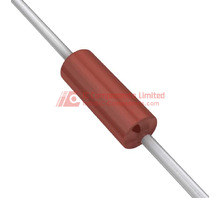
The Vishay Dale CMF5510R600DHBF is a precision metal film through-hole resistor delivering 10.6 ohms resistance with ±0.5% tolerance and 0.5W power dissipation capability. This axial leaded component belongs to the CMF series, designed for applications where tight resistance accuracy, thermal stability, and environmental protection are required in circuit design.
Metal film construction provides superior performance characteristics compared to carbon composition alternatives, including low noise generation and stable electrical behavior across temperature variations. The ±50ppm/°C temperature coefficient ensures resistance remains consistent from -55°C to 175°C, making this resistor suitable for precision analog circuits, voltage dividers, current sensing networks, and instrumentation applications operating in extended temperature environments.
The flame retardant coating combined with moisture resistant protection addresses reliability concerns in industrial control systems, automotive electronics, and measurement equipment exposed to challenging environmental conditions. These protective features extend operational lifespan while maintaining electrical performance in humid atmospheres or where fire safety considerations factor into component selection.
Physical dimensions of 2.29mm diameter by 6.10mm length with axial lead configuration allow straightforward through-hole mounting on PCBs using standard wave soldering or manual assembly processes. The two-termination design integrates into existing board layouts where axial resistors are specified, with the half-watt power rating supporting moderate current applications without requiring additional heat dissipation measures in most circuit designs.
The 10.6 ohm resistance value serves specific impedance matching requirements, current limiting functions in low-voltage circuits, and pullup or pulldown resistor applications where standard E24 or E96 series values don't provide optimal performance. The 0.5% tolerance reduces the need for post-assembly trimming or component selection in precision circuits, streamlining production workflows while maintaining specified circuit parameters.
This active product status component ships in bulk packaging, with availability supporting both prototype development and volume production requirements. The axial form factor remains prevalent in repair operations, legacy system maintenance, and designs where through-hole technology offers mechanical advantages over surface mount alternatives.
When a precision metal film resistor like the CMF5510R600DHBF becomes unavailable due to supply chain constraints, end-of-life transitions, or cost optimization requirements, identifying functionally equivalent alternatives becomes necessary. This 10.6-ohm, 0.5W axial resistor with ±0.5% tolerance serves in applications requiring stable resistance values across temperature variations, moisture exposure, and safety-critical environments. Several manufacturers offer direct cross-references and functionally compatible parts that can serve as replacements: Vishay Beyschlag MBB02070C1069FC100, KOA Speer MF1/2CC1062F, Yageo MFR-25FBF52-10R6, and Panasonic ERO-S2PHF10R6. Each alternative presents distinct electrical characteristics, physical dimensions, and feature sets that influence their suitability for specific circuit requirements.

CMF5510R600DHBF (1)
Understanding the Original Component Specification
The CMF5510R600DHBF belongs to Vishay Dale's CMF55 series, designed for applications where resistance stability, environmental resilience, and physical robustness are required. The metal film construction provides superior temperature coefficient performance compared to carbon composition types, with ±50ppm/°C ensuring minimal resistance drift across the -55°C to 175°C operating range. The 0.5% tolerance specification places this component in the precision resistor category, suitable for voltage dividers, current sensing networks, and reference circuits where accuracy directly affects system performance.
The axial lead configuration with 2.29mm diameter and 6.10mm body length accommodates through-hole assembly processes, particularly in industrial equipment, power supplies, and legacy designs where surface mount alternatives cannot be retrofitted. The flame retardant coating combined with moisture resistance addresses safety standards and reliability requirements in environments subject to humidity, condensation, or contamination exposure. The safety designation indicates compliance with additional testing protocols relevant to medical, transportation, or consumer equipment applications.
Vishay Beyschlag MBB02070C1069FC100 as Direct Functional Equivalent
The MBB02070C1069FC100 from Vishay Beyschlag represents a cross-manufacturer alternative within the same corporate family, offering 10.6 ohms at ±1% tolerance with 0.6W power dissipation capability. The MELF (Metal Electrode Leadless Face) construction differs fundamentally from the CMF55's axial configuration, requiring surface mount assembly rather than through-hole insertion. This physical form factor change necessitates PCB layout modifications and may require reflow profile adjustments during manufacturing.
The tighter temperature coefficient of ±25ppm/°C in the MBB0207 series provides enhanced thermal stability compared to the CMF5510R600DHBF's ±50ppm/°C specification. In precision measurement circuits or temperature-compensated networks, this improved coefficient reduces calibration drift and extends recalibration intervals. However, the slightly relaxed tolerance to ±1% from the original ±0.5% introduces a 0.053-ohm potential variation range, which may affect circuit accuracy in applications where the resistor participates in precision voltage division or current setting functions.
The power rating increase to 0.6W provides an additional 20% thermal margin, beneficial in applications operating near the CMF55's 0.5W limit or in environments with restricted airflow. The operational temperature range of -55°C to 155°C represents a 20°C reduction at the upper limit compared to the original specification, requiring thermal assessment in high-temperature applications such as automotive underhood electronics or industrial process control systems.
KOA Speer MF1/2CC1062F Axial Configuration Match
The MF1/2CC1062F maintains the axial lead form factor of the CMF5510R600DHBF, eliminating the need for PCB redesign or assembly process changes. This 10.6-ohm resistor with ±1% tolerance and 0.5W power rating provides dimensional compatibility within the MF1/2 series body dimensions of 2.3mm diameter and 6.5mm length, closely matching the original 2.29mm x 6.10mm envelope. The minor dimensional variance of 0.4mm in length typically accommodates within standard lead forming tolerances for axial components.
The temperature coefficient specification of ±100ppm/°C represents a twofold reduction in thermal stability compared to the CMF5510R600DHBF. In circuits where the resistor operates across wide ambient temperature ranges or experiences significant self-heating, this degraded coefficient produces proportionally larger resistance variations. For a 10.6-ohm nominal value, a 100°C temperature excursion would introduce a maximum 0.106-ohm shift, compared to 0.053-ohm for the original component. Applications such as precision current sources, active filter networks, or ADC reference dividers may exhibit measurable performance degradation with this specification downgrade.
The standard conformal coating provides moisture protection but lacks the explicit flame retardant and safety certifications of the CMF55 series. Circuit designs subject to UL, IEC, or other safety agency requirements should verify that the MF1/2CC1062F carries equivalent approvals for the specific end-use application. The -55°C to 155°C operating range matches the MBB02070C1069FC100 upper limit, requiring identical thermal validation for high-temperature environments.
Yageo MFR-25FBF52-10R6 Cost-Optimized Alternative
The MFR-25FBF52-10R6 targets cost-sensitive applications where the CMF5510R600DHBF's precision specifications exceed functional requirements. This 10.6-ohm, ±1% tolerance, 0.25W axial resistor operates from -55°C to 155°C with a ±100ppm/°C temperature coefficient. The reduced power rating to 0.25W, half that of the original component, mandates careful power dissipation analysis to prevent thermal stress or premature failure.
Power derating becomes necessary in circuits originally utilizing 40-60% of the CMF55's 0.5W capability. The MFR-25's 0.25W rating requires operation below 50% duty factor for equivalent reliability, or circuit redesign to distribute dissipation across multiple parallel elements. The smaller body dimensions of 1.8mm diameter and 3.6mm length offer space savings in dense PCB layouts but reduce surface area for heat dissipation, accelerating thermal rise for a given power level.
The reduced material content and simplified coating process enable lower per-unit costs, advantageous in high-volume consumer electronics or non-critical industrial applications. However, the absence of explicit flame retardant and moisture resistant designations limits suitability for environments subject to flammability testing or prolonged humidity exposure. The ±1% tolerance and ±100ppm/°C coefficient match the KOA Speer alternative, providing equivalent accuracy limitations for precision circuit applications.
Panasonic ERO-S2PHF10R6 Enhanced Environmental Performance
The ERO-S2PHF10R6 combines 10.6-ohm resistance with ±1% tolerance and 0.5W power rating in an axial metal oxide film construction, offering enhanced pulse load handling and superior humidity resistance compared to standard metal film types. The ±50ppm/°C temperature coefficient matches the CMF5510R600DHBF specification, maintaining thermal stability for precision applications while accepting the tolerance relaxation to ±1%.
Metal oxide film technology exhibits higher dielectric strength and improved voltage coefficient characteristics, particularly relevant in high-voltage bias networks or circuits experiencing transient overvoltage conditions. The construction withstands momentary overload pulses more effectively than thin metal film types, beneficial in power supply filtering, inrush current limiting, or EMI suppression applications. The body dimensions of 2.5mm diameter and 6.5mm length fall within typical axial component footprints, though the slightly increased diameter may require lead spacing verification.
The operating temperature range extends from -55°C to 155°C, consistent with other alternatives but reduced from the CMF55's 175°C maximum. The conformal coating includes moisture protection suitable for high-humidity environments, though explicit safety agency certifications should be verified for regulated applications. The combination of matched temperature coefficient, maintained power rating, and enhanced pulse capability makes this alternative particularly suitable for power electronics and industrial control systems.
Comparative Analysis of Key Replacement Parameters
The four alternatives present distinct tradeoff profiles across electrical performance, physical compatibility, and application suitability dimensions. Tolerance specifications show uniform relaxation from the CMF5510R600DHBF's ±0.5% to ±1% across all candidates, doubling the potential resistance variation range from ±0.053 ohms to ±0.106 ohms. This degradation affects circuit accuracy proportionally, requiring error budget recalculation for precision applications.
Temperature coefficient performance divides the alternatives into two groups: the Vishay MBB02070C1069FC100 improves to ±25ppm/°C while the Panasonic ERO-S2PHF10R6 matches the original ±50ppm/°C, whereas both KOA Speer and Yageo options degrade to ±100ppm/°C. For a representative 100°C temperature swing, resistance drift ranges from 0.0265 ohms (MBB0207) to 0.106 ohms (MF1/2 and MFR-25), directly impacting thermal stability in temperature-varying environments.
Power ratings span from the Yageo MFR-25's reduced 0.25W capacity through the original 0.5W specification maintained by KOA Speer and Panasonic, to the enhanced 0.6W capability of the Vishay MELF alternative. Physical form factors divide between the three axial options (KOA, Yageo, Panasonic) preserving drop-in compatibility versus the Vishay MELF requiring surface mount conversion. Body dimensions cluster within 1.8-2.5mm diameter and 3.6-6.5mm length ranges, with the Yageo variant offering the most compact envelope.
Environmental protection features vary from basic conformal coating on the Yageo and KOA parts through moisture resistant specifications on the Panasonic metal oxide construction to the comprehensive flame retardant, moisture resistant, and safety ratings of the original CMF55 series. Operating temperature upper limits uniformly reduce to 155°C across all alternatives except the original 175°C specification, requiring thermal margin verification for high-temperature applications.
Validation Methodology for Replacement Confirmation
Using the Panasonic ERO-S2PHF10R6 as the validation example, several bench-level verification steps confirm functional compatibility before full production integration. Initial resistance measurement at 25°C ambient should demonstrate values within the combined tolerance range of ±1%, verifying baseline accuracy against the original ±0.5% specification. A calibrated multimeter with 0.01-ohm resolution provides sufficient measurement precision for this verification, with multiple samples measured to establish population distribution.
Temperature coefficient validation requires controlled thermal cycling between -40°C and 125°C while monitoring resistance values at 25°C intervals. Plotting resistance deviation versus temperature reveals the actual coefficient performance, confirming adherence to the ±50ppm/°C specification across the operating range. For a 10.6-ohm nominal value, a 100°C temperature change should produce less than 0.053-ohm resistance shift; deviations exceeding this threshold indicate either specification non-compliance or measurement error requiring investigation.
Power dissipation testing applies 70-80% of the rated 0.5W capacity in a thermal chamber at maximum ambient temperature, monitoring case temperature rise and long-term resistance stability. The component should reach thermal equilibrium without exceeding the maximum operating temperature of 155°C, with resistance values remaining within tolerance after 1000-hour aging at rated power. Thermal imaging identifies hot spots or mounting stress points that could affect reliability in production assemblies.
Pulse handling verification becomes particularly relevant for the metal oxide film construction of the ERO-S2PHF10R6, which claims superior transient response compared to thin film types. Applying controlled voltage pulses at twice the rated continuous power for 100-microsecond durations while monitoring resistance changes validates pulse withstand capability. Applications subject to repetitive transients, such as switching power supplies or motor control circuits, benefit from this validation to confirm enhanced pulse tolerance delivers practical advantage over the original metal film construction.
Decision Framework for Optimal Alternative Selection
Circuit designs requiring dimensional compatibility without PCB modification should prioritize the axial alternatives: KOA Speer MF1/2CC1062F, Yageo MFR-25FBF52-10R6, or Panasonic ERO-S2PHF10R6. Among these, applications operating near the original 0.5W power rating eliminate the Yageo option due to inadequate thermal capacity, narrowing selection to KOA or Panasonic based on temperature coefficient requirements and environmental exposure conditions.
Precision circuits where thermal stability determines system accuracy benefit from either the Vishay MBB02070C1069FC100's superior ±25ppm/°C coefficient or the Panasonic ERO-S2PHF10R6's maintained ±50ppm/°C performance. The surface mount conversion required for the MELF package offsets its electrical advantages unless PCB redesign aligns with planned product refreshes or enables density improvements justifying the transition effort.
Cost-driven applications accepting reduced power handling and thermal stability find the Yageo MFR-25FBF52-10R6 attractive when dissipation remains well below 0.25W and operating temperatures avoid extreme ranges. High-volume production benefits from the per-unit cost reduction, provided reliability testing confirms adequate performance margins for the intended application environment.
Power electronics and industrial control systems subject to transient overloads, high humidity, or vibration stress favor the Panasonic ERO-S2PHF10R6's metal oxide construction, enhanced pulse capability, and superior moisture resistance. The maintained temperature coefficient and power rating preserve the original design margins while the improved pulse handling provides additional protection against abnormal operating conditions.